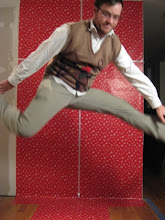
Ted made a list, inspiring me to do the same.
1) That I was wrong about thinking I shouldn't move in with my boyfriend.
2) A warm bed filled with my kitties.
3) Art on every wall, everywhere.
4) The complicated relationship to your writing that being published creates.
5) Good reviews.
6) New York City's utter, unflappable, inspiring awesomeness.
7) Kip.
8) Kip's patience with my everything.
9) Friends who live very close by.
10) Parents who get it.
11) Central Air.
12) The Greenmarket community.
13) My editor & my agent. Because everyone said that Yield wasn't publishable except for them, and turns out, it was.
14) That I have a desk job where I can iChat with Cory and Robert and Jeff.
15) That Howie made enough of the best maple syrup in the world to keep me employed another year.
16) Complicated questions that people ask and struggle to answer well.
17) The DVR.
18) Antibiotics.
19) The MoMA, The Met Museum, The Whitney, The Guggenheim, etc.
20) Jokes.
21) The Theater Development Fund.
22) The incredible bounty of local food.
23) Poets.
24) Homosexuals.
25) Having friends in so many lines of work: dentists, psychotherapists, drummers, photographers, teachers, graphic designers, fashion thinkers, singers, DOT workers, performers, artists, writers, journalists, bartenders, farmers, waiters, chefs, lawyers, zine-makers, dancers, yoga teachers, real estate agents, puppeteers, activists, old folks home managers, playwrights, actors, film editors, sound technicians, and circus performers.
Showing posts with label art. Show all posts
Showing posts with label art. Show all posts
Sunday, November 28, 2010

Monday, November 22, 2010
Scattered Light
The other night, I took this video of Jim Campbell's new outdoor sculpture "Scattered Light." There are a few pieces in the park, but the only one you will care about seeing is this one, which is described as:
Scattered Light, will feature nearly 2,000 LEDs encased in standard light bulbs, suspended within a support structure spanning 80 feet in length and standing 20 feet high and 16 feet wide to create a vibrant light grid across the center of Madison Square Park’s Oval Lawn. The LED bulbs, programed to flicker scattered light, will create the illusion of figurative images that explore and reflect the human experience amidst the urban landscape, creating the appearance of giant human shadows crossing a floating 3-D matrix of light. As one travels around the piece, the vantage point alters and the light figures begin to abstract, blurring the boundaries between image and object.Scattered Light is on view until February 2011. More about it by looking here.
Tuesday, October 26, 2010
Sunday Morning
I was doing some research on ARTstor the other day. (ARTstor is an on-line repository of thousands of images from hundreds of institutions across the world. If you are looking for inspiration and Google images ain't doing it for ya, I highly recommend them.) I managed to come across the many variations of "Sunday morning" in art throughout the years. It seems that since the beginning, mornings on Sundays have been the kind of quiet, thoughtful, restorative moments that we all look forward to at the end of the week.Here are some of those Sunday mornings:

Sunday Morning in front of the Arch Street Meeting House, Philadelphia
Attributed to, John Lewis Krimmel, 1811- ca. 1813

Thomas Hovenden
Sunday Morning, 1881

Mary Heilmann
Sunday Morning, 1986
And of course:

Edward Hopper
Early Sunday Morning,
Monday, October 04, 2010

Friday, March 12, 2010
Being Present
I am thinking these days about presence. About what creates it. About what makes it real, or maybe palpable, since what is real and what is unreal, these days, I find difficult to decipher. (And, of course, the other huge question here is: Does real matter?) More specifically, I am thinking about how much energy it takes to be present. To respect another person's presence by showing up, by becoming present yourself.
I am first thinking of how being present can take everything out of you. As evidence: me standing on South 4th Street and Bedford Avenue, waiting on the blessed B62 (which, by the way, hasn't gotten better since the restructuring.) There was a man standing there as well, mid 50s maybe, something slightly off-kilter about his clothing. (But this is New York, and you never know anything about anyone, really.) I notice that he's looking at me. Not looking at me like one New Yorker looks at another New Yorker. He's trying to make eye contact. I get the feeling that he wants to ask me something. (This is natural at the bus stop. People often have logistical or directional questions at bus stops, and I, apparently, look like the kind of person who has the answers.) So, I take the bait, and look back at him.
"My wife died," he said. "Two weeks ago. She was 62 years old." "I'm sorry," I said. He said thank you, and we stood there a minute, quietly, waiting on the bus, with this fact suddenly between us.
For the rest of the day I carried all that around with me, and before I crawled into bed, I spent an hour playing thrashy folk songs on the guitar, maybe annoying the neighbors, until all that was out of me and I felt like myself again. He needed to say it out loud. He needed to give some of the weight to someone else so that he could go on with the motion of living. This makes sense to me. Sometimes saying something out loud can make it real. Or sometimes we say things out loud that aren't true at all, and it's a way of feeling the realness of them, if only an instant, like trying on a new pair of strange glasses, or like sliding your feet into a pair of your father's shoes. That guy just needed me to be present. Or, by default, my presence contributed his relief. Even if he made it all up, I was there, and we shared that weird, horrible, tragic conversation. And there was nothing to say afterward.
Second, I went to MoMA to see the Marina Abromovic retrospective. In addition to filling the 6th floor with lots of photos and videos, there are several recreations, or "reperformances" as Abromovic is calling them, by actors, dancers and other performance artists, of her previous work. Meanwhile, for the duration of the exhibit--about 700 hours that is--Abromovic herself will be seated at a table in the main atrium. Museum guests are invited to sit across from her for a duration of their choosing and do nothing but meet her gaze and feel whatever you feel, in a piece called "The Artist is Present." This is what it looks like, from the outside:

Sitting in a chair for an hour is difficult. Try it for 700 hours, all the while under the gaze of lights, viewers, the art world, critics, fans, people who hate you, etc. Marina ain't kidding, y'all. I've been thinking so much about presence after seeing this piece because of the way the reperformances failed to create the kind of excitement, mystery, emotion, verve--any of the things you feel when you see "The Artist is Present" in the Atrium.
So then what is creating that feeling? The situation is so simple, and other than blinking and the slight movement from her breathing, she didn't move at all for the half hour I stood watching her. So how can it be that the reperformances don't carry the same weight, if the actions are the same as in the original pieces? And Abromovic herself has been coaching and training the performers for the past several weeks. It begs the question, what is performance? Is it the sum of the actions, or is it the intention behind the actions? (I recall Yeats here and "how can we know the dancer from the dance?") And if the reperformers are supposed to be truly in the moment, and truly present, then why not call them performers? Why divide the past from the present, if what you are looking for--I think--is the magic of the moment?
In the new piece, Abromovic is basically doing everything at once, controlling every aspect, either directly or indirectly, by just being present. One museum-goer opted to sit across from her for about two hours. This made me angry--this person was taking up so much time, other people were waiting, how selfish! But what does that say about my sense of time? What does that say about my own selfishness? What does it say about what I think about the act of being present, and the limits, or extensions of it?
One of the things I like most about "The Artist is Present" is that the catalog copy calls the piece "generous." Such a rarity in art, I think. A kind of slow, meaningful present generosity.
I am first thinking of how being present can take everything out of you. As evidence: me standing on South 4th Street and Bedford Avenue, waiting on the blessed B62 (which, by the way, hasn't gotten better since the restructuring.) There was a man standing there as well, mid 50s maybe, something slightly off-kilter about his clothing. (But this is New York, and you never know anything about anyone, really.) I notice that he's looking at me. Not looking at me like one New Yorker looks at another New Yorker. He's trying to make eye contact. I get the feeling that he wants to ask me something. (This is natural at the bus stop. People often have logistical or directional questions at bus stops, and I, apparently, look like the kind of person who has the answers.) So, I take the bait, and look back at him.
"My wife died," he said. "Two weeks ago. She was 62 years old." "I'm sorry," I said. He said thank you, and we stood there a minute, quietly, waiting on the bus, with this fact suddenly between us.
For the rest of the day I carried all that around with me, and before I crawled into bed, I spent an hour playing thrashy folk songs on the guitar, maybe annoying the neighbors, until all that was out of me and I felt like myself again. He needed to say it out loud. He needed to give some of the weight to someone else so that he could go on with the motion of living. This makes sense to me. Sometimes saying something out loud can make it real. Or sometimes we say things out loud that aren't true at all, and it's a way of feeling the realness of them, if only an instant, like trying on a new pair of strange glasses, or like sliding your feet into a pair of your father's shoes. That guy just needed me to be present. Or, by default, my presence contributed his relief. Even if he made it all up, I was there, and we shared that weird, horrible, tragic conversation. And there was nothing to say afterward.
Second, I went to MoMA to see the Marina Abromovic retrospective. In addition to filling the 6th floor with lots of photos and videos, there are several recreations, or "reperformances" as Abromovic is calling them, by actors, dancers and other performance artists, of her previous work. Meanwhile, for the duration of the exhibit--about 700 hours that is--Abromovic herself will be seated at a table in the main atrium. Museum guests are invited to sit across from her for a duration of their choosing and do nothing but meet her gaze and feel whatever you feel, in a piece called "The Artist is Present." This is what it looks like, from the outside:

Sitting in a chair for an hour is difficult. Try it for 700 hours, all the while under the gaze of lights, viewers, the art world, critics, fans, people who hate you, etc. Marina ain't kidding, y'all. I've been thinking so much about presence after seeing this piece because of the way the reperformances failed to create the kind of excitement, mystery, emotion, verve--any of the things you feel when you see "The Artist is Present" in the Atrium.
So then what is creating that feeling? The situation is so simple, and other than blinking and the slight movement from her breathing, she didn't move at all for the half hour I stood watching her. So how can it be that the reperformances don't carry the same weight, if the actions are the same as in the original pieces? And Abromovic herself has been coaching and training the performers for the past several weeks. It begs the question, what is performance? Is it the sum of the actions, or is it the intention behind the actions? (I recall Yeats here and "how can we know the dancer from the dance?") And if the reperformers are supposed to be truly in the moment, and truly present, then why not call them performers? Why divide the past from the present, if what you are looking for--I think--is the magic of the moment?
In the new piece, Abromovic is basically doing everything at once, controlling every aspect, either directly or indirectly, by just being present. One museum-goer opted to sit across from her for about two hours. This made me angry--this person was taking up so much time, other people were waiting, how selfish! But what does that say about my sense of time? What does that say about my own selfishness? What does it say about what I think about the act of being present, and the limits, or extensions of it?
One of the things I like most about "The Artist is Present" is that the catalog copy calls the piece "generous." Such a rarity in art, I think. A kind of slow, meaningful present generosity.
Wednesday, December 16, 2009


Tuesday, December 08, 2009
Advertisting Blanks
One of my favorite things about the MTA are the sections of tile in advertising transition. The many layers of posters and graffiti become modern art pieces themselves. I love how these are created randomly, and yet always come out looking so beautiful.
Do you have some of these at your station? Send them to me and I will add them here.


Do you have some of these at your station? Send them to me and I will add them here.


Monday, October 05, 2009

Tuesday, July 28, 2009
What I'm Thinking About Lately
--I'm coming up on 500 blog posts. I guess maybe I should think about what the blog has done for me, and maybe what it hasn't. How it has changed the way I write, the way I think about writing, the way I think about what it means to make writing for free, and give it away for free. I find that even though I'm not particularly interested in marking certain passages--year marks, large round numbers--I am also compelled to mark them, as evidence. Of something.
--I am ambivalent about everything. Perhaps too much.
--Does supplemental material change the perception of a work of art? I'm thinking about this age of DVD commentary, bonus tracks, and so on. I think about Doris Salcedo's work "Shibboleth," which was at the Tate Modern in 2007. She wouldn't discuss how the crack was made--and that actually made the work less interesting to me. Perhaps because the feat of it was so startling. I'm with her, in some senses--the work stands alone. But...
--Antony Gormley's current work of art, in London, "One & Other." Basically, for 100 days, 2400 members of the public will stand on the vacant fourth plinth in Trafalgar Square for an hour each. Watching the public use this moment--their 1 hour of a certain kind of fame--has been interesting. People are using it to raise awareness for a certain cause....or they are hanging out, taking pictures, having tea. It's interesting to me to think about use, and identity, and art, and how all these things are crammed in together with activism--which I never even thought about until the public started bringing signs and stuff with them to their hour on the plinth. This brings about the question of visibility, and what that means.
--I used to have a lot of sadness about finishing my novel--only in that you're essentially killing off people who have lived in your brain for so long, your friends in the loneliest of times. But, for whatever reason, it never occurred to me that, actually, in finishing it--you're giving them life, forever. (Or, as least, as long as you remain in print.)
--I am ambivalent about everything. Perhaps too much.
--Does supplemental material change the perception of a work of art? I'm thinking about this age of DVD commentary, bonus tracks, and so on. I think about Doris Salcedo's work "Shibboleth," which was at the Tate Modern in 2007. She wouldn't discuss how the crack was made--and that actually made the work less interesting to me. Perhaps because the feat of it was so startling. I'm with her, in some senses--the work stands alone. But...
--Antony Gormley's current work of art, in London, "One & Other." Basically, for 100 days, 2400 members of the public will stand on the vacant fourth plinth in Trafalgar Square for an hour each. Watching the public use this moment--their 1 hour of a certain kind of fame--has been interesting. People are using it to raise awareness for a certain cause....or they are hanging out, taking pictures, having tea. It's interesting to me to think about use, and identity, and art, and how all these things are crammed in together with activism--which I never even thought about until the public started bringing signs and stuff with them to their hour on the plinth. This brings about the question of visibility, and what that means.
--I used to have a lot of sadness about finishing my novel--only in that you're essentially killing off people who have lived in your brain for so long, your friends in the loneliest of times. But, for whatever reason, it never occurred to me that, actually, in finishing it--you're giving them life, forever. (Or, as least, as long as you remain in print.)
Wednesday, July 08, 2009
Letter from Greece, Part 4 of 10
Day Two: Athens
By accident, we sleep until two o’clock in the afternoon. I wake up once or twice in the night, my usual amount of insomnia, currently stuck on level five out of ten. I don’t check the clock, for fear that it might be earlier than I can bear. Every time I turn over, fussing with the pillows, I worry that it might be three, four, five in the morning, and I will have to lay there, bored and anxious until a reasonable waking hour. It never occurs to me that it could be noon.
At the same corner coffee shop we buy “Greek salad sandwiches” from the same blonde woman. Is she the owner? The waiter? The fill-in? She seems not to recognize us, and I wonder if perhaps we look like every other set of American tourists that stroll through to buy a cup of coffee, or drink a beer and smoke a cigarette. Something about her seems so shy, and she seems to understand so little, despite all the hand-written signs in English, that even my rudimentary (or just rude?) pointing is met with a stare. But she takes our money, wraps the sandwiches in wax paper, and smiles. “Enjoy,” she says, and then I wonder if I’ve misunderstood the entire interaction. The sandwich is a floury baguette with olives, feta and tomato. It makes a perfect breakfast.
Clearly, the architects and designers involved in building the Parthenon wanted the reveal to be a spectacular event. You hike through the scrubby trees and brush along the pathways up the west side of the Acropolis, emerge from the narrow width of the dramatic Propylaia, to find the Parthenon set back in three-quarter view. Imagine the structure untarnished, elaborately colored, incredibly rich—most importantly, complete. Stories of wars and celebrations were depicted in sculptures along the roofline, some life-size, in stunning detail. For the Greek people, the visit must have been a deeply satisfying, transformative experience.
All around the Parthenon there are huge chunks of marble, as if the entire structure had exploded—at one point it did, under the Ottomans, who were using it as a gunpowder magazine. The area looks like my five year-old nephew’s playroom, building blocks in every configuration of stacked, toppled, and forgotten. There is new marble waiting to be matched and assembled as part of the current restoration efforts, and there is ancient marble—all of it from the famous quarry at Mount Pentelikos—cracked and worn by 2,500 years of wind, rain, pollution, fire, earthquakes, canons, restless infantry, the Christians, the Muslims, the Turks, the Venetians, and the British. Finally, the 20th Century American and Italian tourists wearing high heels are carving divots into the walkways.
On the southern slope of the Acropolis, there is the Odeon of Herodes Atticus, which is still in modern use, seating about 5,000. “Memorable performances,” according to some on-site literature, include the return of Nana Mouskouri after a two-decade absence, and Yanni’s “landmark” 1993 performance. During our visit, the stage is being prepped for a production of Aida, with huge Egyptian obelisks being moved through a deep red proscenium.
Everywhere there are structures, and the remains of structures. There is the Theatre of Dionysus Eleuthereus, the Sanctuary of Asclepius, the Odeum of Pericles, the Temple of Athena Nike, the Stoa of Eumene—all bearing the enormous crushing weight of layers and layers of history, revised and repaired, rethought and repurposed. We hear this story over and over again in Greece—the Romans replacing the marble or stealing the marble, the Christians dedicating the Parthenon to the Virgin Mary, the Greeks themselves moving statues and buildings, the frescoes buried underground during the war, more fakes on display. I keep wondering what remains of a culture that has re-imagined itself for more than 2,000 years.
On the northern side of the Acropolis, there is the Erechtheum, with its striking Porch of the Caryatids: six women, draped in fabric, holding up the roof with their heads. Some of the original statues are displayed in—so I’m told—helium-filled glass cases, in the not-yet-open-to-the-public Acropolis Museum; the ones on the actual Acropolis are replicas. Lord Elgin, perhaps the most famous looter of Greek artwork, had one of the original Caryatids removed and later displayed at his sprawling estate. At night, they say you can hear the statues crying out, wailing for their missing sister.
But we don’t hear any crying.
Do the replicas cry out? Or the originals, now drowning in helium? I try to get a sense of how the ancient mythology might interact with daily life today—but no one wants to talk about that. They only want to talk about how polytheism is crazy, about what the ancients did and didn’t do on the most basic behavioral level, nothing about what it meant to them, how it felt to be them. Tourism, or maybe plain old capitalism, has co-opted the culture, dimmed it, and arguably destroyed it. Contemporary Greece seems to say, about the past, only: “Here, buy this plastic toy Parthenon for two Euros.” When I visit the Lincoln Memorial—a structure that owes so much to the Parthenon in look and feel and use—I get a small sense of a living idea at work, a striving. In Athens, I can’t figure out why everything around me feels dead.
For dinner, we end up at Estia, a lively modern café in the heart of the Plaka, the oldest neighborhood in Athens, full of restaurants and souvenir shops. I try to order the local sheep cheese, which, as the menu states, comes with honey and sesame seeds. The waiter promises that we won’t like it, and bullies us into the saganaki: fried cheese, not a horrible choice. We eat more grilled lamb, a delicious mousaka, various dips and garlicky things, and finally end with a warm chunk of walnut pie, and shots of cinnamon schnapps.
Across from our table is the entrance to an open-air movie theater, on the roof of what appears to be an art gallery. There is one 11:15pm showing of the Ron Howard-directed “Angels & Demons,” which, in Greece, has been renamed “Something something something Illuminati.” The movie is horrendously bad, a grotesque insult to the intelligence of the audience. (Or maybe I am mistaking the film’s audience.) At one point, Ewan McGregor flies a helicopter straight up into the night, above the Vatican, so that when the anti-matter explodes it doesn’t kill everyone—no, really. It was a marvelous experience: a rooftop in Athens, the glowing Parthenon set back on the hill, the cooling night air, street cats slinking through the holes in the fence, cold beer.
Back at the hotel, we watch an episode of “America’s Next Top Model,” with sections dubbed into Greek, and CNN, with Anderson Cooper interviewing Ani Difranco about her visit to Myanmar. There are advertisements for cream-filled croissants in various flavors, which are made, it seems, by cartoon bumble bees with giant eyes. There is “Scandal” brand ice cream in square boxes that old ladies eat with wooden spoons. There are 6:00am morning shows with goofy hosts, dressed ready for a nightclub. There are cheap exercise machines sold along side cellulite creams, with manicured hands massaging thick, pasty thighs. Then there is Jessica Alba selling some kind of watch, or was it just a piece of jewelry? This, I think—advertising—is the language that I will never understand.
When I’m awake at 4:40am—insomnia on 6 out of 10—I wonder if maybe it’s the jetlag, just my confused internal clock. William Gibson wrote that jetlag was the slow-moving soul trying to catch up to the body, which had crossed the globe at higher speeds. This sounds about right. I entertain myself by trying to remember each item in the minibar from left to right: milk chocolate Toblerone, that purple-wrapped candy bar with the white goop inside, two cans of Coca-Cola, one can of Coke Light, one box of orange juice, one bottle white wine, one bottle champagne. The door is filled with tiny bottles of liquor, amber and clear and one that looks like pale blue antifreeze. There seemed to be one more thing. What was it?
By accident, we sleep until two o’clock in the afternoon. I wake up once or twice in the night, my usual amount of insomnia, currently stuck on level five out of ten. I don’t check the clock, for fear that it might be earlier than I can bear. Every time I turn over, fussing with the pillows, I worry that it might be three, four, five in the morning, and I will have to lay there, bored and anxious until a reasonable waking hour. It never occurs to me that it could be noon.
At the same corner coffee shop we buy “Greek salad sandwiches” from the same blonde woman. Is she the owner? The waiter? The fill-in? She seems not to recognize us, and I wonder if perhaps we look like every other set of American tourists that stroll through to buy a cup of coffee, or drink a beer and smoke a cigarette. Something about her seems so shy, and she seems to understand so little, despite all the hand-written signs in English, that even my rudimentary (or just rude?) pointing is met with a stare. But she takes our money, wraps the sandwiches in wax paper, and smiles. “Enjoy,” she says, and then I wonder if I’ve misunderstood the entire interaction. The sandwich is a floury baguette with olives, feta and tomato. It makes a perfect breakfast.
Clearly, the architects and designers involved in building the Parthenon wanted the reveal to be a spectacular event. You hike through the scrubby trees and brush along the pathways up the west side of the Acropolis, emerge from the narrow width of the dramatic Propylaia, to find the Parthenon set back in three-quarter view. Imagine the structure untarnished, elaborately colored, incredibly rich—most importantly, complete. Stories of wars and celebrations were depicted in sculptures along the roofline, some life-size, in stunning detail. For the Greek people, the visit must have been a deeply satisfying, transformative experience.
All around the Parthenon there are huge chunks of marble, as if the entire structure had exploded—at one point it did, under the Ottomans, who were using it as a gunpowder magazine. The area looks like my five year-old nephew’s playroom, building blocks in every configuration of stacked, toppled, and forgotten. There is new marble waiting to be matched and assembled as part of the current restoration efforts, and there is ancient marble—all of it from the famous quarry at Mount Pentelikos—cracked and worn by 2,500 years of wind, rain, pollution, fire, earthquakes, canons, restless infantry, the Christians, the Muslims, the Turks, the Venetians, and the British. Finally, the 20th Century American and Italian tourists wearing high heels are carving divots into the walkways.
On the southern slope of the Acropolis, there is the Odeon of Herodes Atticus, which is still in modern use, seating about 5,000. “Memorable performances,” according to some on-site literature, include the return of Nana Mouskouri after a two-decade absence, and Yanni’s “landmark” 1993 performance. During our visit, the stage is being prepped for a production of Aida, with huge Egyptian obelisks being moved through a deep red proscenium.
Everywhere there are structures, and the remains of structures. There is the Theatre of Dionysus Eleuthereus, the Sanctuary of Asclepius, the Odeum of Pericles, the Temple of Athena Nike, the Stoa of Eumene—all bearing the enormous crushing weight of layers and layers of history, revised and repaired, rethought and repurposed. We hear this story over and over again in Greece—the Romans replacing the marble or stealing the marble, the Christians dedicating the Parthenon to the Virgin Mary, the Greeks themselves moving statues and buildings, the frescoes buried underground during the war, more fakes on display. I keep wondering what remains of a culture that has re-imagined itself for more than 2,000 years.
On the northern side of the Acropolis, there is the Erechtheum, with its striking Porch of the Caryatids: six women, draped in fabric, holding up the roof with their heads. Some of the original statues are displayed in—so I’m told—helium-filled glass cases, in the not-yet-open-to-the-public Acropolis Museum; the ones on the actual Acropolis are replicas. Lord Elgin, perhaps the most famous looter of Greek artwork, had one of the original Caryatids removed and later displayed at his sprawling estate. At night, they say you can hear the statues crying out, wailing for their missing sister.
But we don’t hear any crying.
Do the replicas cry out? Or the originals, now drowning in helium? I try to get a sense of how the ancient mythology might interact with daily life today—but no one wants to talk about that. They only want to talk about how polytheism is crazy, about what the ancients did and didn’t do on the most basic behavioral level, nothing about what it meant to them, how it felt to be them. Tourism, or maybe plain old capitalism, has co-opted the culture, dimmed it, and arguably destroyed it. Contemporary Greece seems to say, about the past, only: “Here, buy this plastic toy Parthenon for two Euros.” When I visit the Lincoln Memorial—a structure that owes so much to the Parthenon in look and feel and use—I get a small sense of a living idea at work, a striving. In Athens, I can’t figure out why everything around me feels dead.
For dinner, we end up at Estia, a lively modern café in the heart of the Plaka, the oldest neighborhood in Athens, full of restaurants and souvenir shops. I try to order the local sheep cheese, which, as the menu states, comes with honey and sesame seeds. The waiter promises that we won’t like it, and bullies us into the saganaki: fried cheese, not a horrible choice. We eat more grilled lamb, a delicious mousaka, various dips and garlicky things, and finally end with a warm chunk of walnut pie, and shots of cinnamon schnapps.
Across from our table is the entrance to an open-air movie theater, on the roof of what appears to be an art gallery. There is one 11:15pm showing of the Ron Howard-directed “Angels & Demons,” which, in Greece, has been renamed “Something something something Illuminati.” The movie is horrendously bad, a grotesque insult to the intelligence of the audience. (Or maybe I am mistaking the film’s audience.) At one point, Ewan McGregor flies a helicopter straight up into the night, above the Vatican, so that when the anti-matter explodes it doesn’t kill everyone—no, really. It was a marvelous experience: a rooftop in Athens, the glowing Parthenon set back on the hill, the cooling night air, street cats slinking through the holes in the fence, cold beer.
Back at the hotel, we watch an episode of “America’s Next Top Model,” with sections dubbed into Greek, and CNN, with Anderson Cooper interviewing Ani Difranco about her visit to Myanmar. There are advertisements for cream-filled croissants in various flavors, which are made, it seems, by cartoon bumble bees with giant eyes. There is “Scandal” brand ice cream in square boxes that old ladies eat with wooden spoons. There are 6:00am morning shows with goofy hosts, dressed ready for a nightclub. There are cheap exercise machines sold along side cellulite creams, with manicured hands massaging thick, pasty thighs. Then there is Jessica Alba selling some kind of watch, or was it just a piece of jewelry? This, I think—advertising—is the language that I will never understand.
When I’m awake at 4:40am—insomnia on 6 out of 10—I wonder if maybe it’s the jetlag, just my confused internal clock. William Gibson wrote that jetlag was the slow-moving soul trying to catch up to the body, which had crossed the globe at higher speeds. This sounds about right. I entertain myself by trying to remember each item in the minibar from left to right: milk chocolate Toblerone, that purple-wrapped candy bar with the white goop inside, two cans of Coca-Cola, one can of Coke Light, one box of orange juice, one bottle white wine, one bottle champagne. The door is filled with tiny bottles of liquor, amber and clear and one that looks like pale blue antifreeze. There seemed to be one more thing. What was it?
Monday, December 01, 2008

Tuesday, July 29, 2008
Waterfalls / AMOK / Busy Busy Busy
--A few of us went yesterday to see Olafur Eliasson's "Waterfalls," which is a very large, very expensive public art installation on the East River. I decided earlier in the year, upon seeing a horrible but earnest dance performance, that I was going to see if I could spend 2008 not hating on other artist's work. But: I just don't see what's impressive about them. Firstly, they are, if you ask me, quite ugly. Scaffolding? Really? Eliasson says on the project's website that he used scaffolding because it is a "common part of New York City's landscape." OK, so it's part of our landscape, but it's also ugly. When the wind blows the water back through the scaffolding, that's when the work really starts to look cheap. Also, these oil-spill-style barriers at the base of each waterfall? I'm not feeling you, Olafur.
--Circus Amok is in full swing. At least my side of things. The shows run September 6-28, in fifteen different city parks throughout the boroughs. Do you fear for the health of your mortgage? Do you love Glinda the Good Witch? Do you ache for the pumping dimensions of disco? Are you party to particle physics? It's all here, baby. More updates soon....
--I'm busy with a few of projects that I hope to share with you soon. Some writing, some reading, a new idea for my old novel. It occurred to me that I'd like to give it some kind of life, whatever life it might be able to have. Look for that happening in the fall. There's also some September happenings, with my friend and fellow queer writer, Charlie Vazquez. And then more publishing ventures in November--two somehow opposing, and yet complimentary anthologies.
Apologies for the slowness of the updates. It's that time of year.
--Circus Amok is in full swing. At least my side of things. The shows run September 6-28, in fifteen different city parks throughout the boroughs. Do you fear for the health of your mortgage? Do you love Glinda the Good Witch? Do you ache for the pumping dimensions of disco? Are you party to particle physics? It's all here, baby. More updates soon....
--I'm busy with a few of projects that I hope to share with you soon. Some writing, some reading, a new idea for my old novel. It occurred to me that I'd like to give it some kind of life, whatever life it might be able to have. Look for that happening in the fall. There's also some September happenings, with my friend and fellow queer writer, Charlie Vazquez. And then more publishing ventures in November--two somehow opposing, and yet complimentary anthologies.
Apologies for the slowness of the updates. It's that time of year.
Sunday, May 25, 2008
Upcoming Excitement
Here's what's on the horizon that excites me:
--Cyndi Lauper, B-52s and the Indigo Girls at Radio City Music Hall
--Circus AMOK! planning and stuff.
--New AMOK! executive director.
--A friend says Amy Ray has a new record on the horizon.
--I'm taking a day off to see August: Osage County.
--Jeff Koons on the roof at the Met.
--Memorial Day picnic in the park with all the peeps.
--4th of July in Chattanooga with my family, and Kip!, and Nephews.
--I'm gonna be in two more queer anthologies in the fall. (Maybe that first novel does actually get published, only one chapter at a time, in 30 different volumes.)
--Cyndi Lauper, B-52s and the Indigo Girls at Radio City Music Hall
--Circus AMOK! planning and stuff.
--New AMOK! executive director.
--A friend says Amy Ray has a new record on the horizon.
--I'm taking a day off to see August: Osage County.
--Jeff Koons on the roof at the Met.
--Memorial Day picnic in the park with all the peeps.
--4th of July in Chattanooga with my family, and Kip!, and Nephews.
--I'm gonna be in two more queer anthologies in the fall. (Maybe that first novel does actually get published, only one chapter at a time, in 30 different volumes.)
Tuesday, December 18, 2007
Banksy does New York (Sort Of.)
Mario was in town from Ithaca this week, so we galloped over to the Vanina Holasek Gallery to see the Banksy show, which is not authorized by the artist himself, but collaged together by the gallery. The works have been, according to the gallery's website, "privately sourced, over a period of time, especially for this show."
Clearly. The show is a mish-mash of prints and a few originals scattered throughout the gallery, which is a converted townhouse with staircases of Himalayan proportions. The work is hung upside down, crooked, sideways. The walls are spattered in something that I guess we're supposed to take for blood. The walls are scrawled with text which is, I guess, Banksy-esque. Some of the prints are still wrapped in bubble wrap, torn open to reveal the image.
But I think the problem lies in Banksy's work, not as much in the slapdash, money-grubbing way it's all been assembled. The price list is posted periodically, everything is in the five-figures, save for a few small things--tee-shirts, posters, postcards. The prices are also written in dark pencil, in quick, lazy handwriting, beside each piece. I guess that's something Banksy would do--post it all in a way that feels ridiculous and overdone--his interaction with the commerce-side of his artwork (read: art career) has been well publicized. (In February of this year, Banksy, after much of his work sold for over 350,000 pounds, put an picture on his website of people bidding on a picture which read, "I Can't Believe You Morons Actually Buy This Shit.")
Of course, with someone as hot as he is right now, the gallery was quite full. Probably 20 people total, which is 18 more than every other gallery we strolled into. I guess that counts for something. And there's always the argument that Banksy's laughing all the way to the bank. Who cares? A lot of people laugh all the way to the bank, but they do it selling stocks or they play the lottery, or they win American Idol. Why is "all the way to the bank" the response which suddenly validates something that sucks?
The actual graffiti pieces, in London primarily, have a much more interesting effect than the works on paper. And I completely appreciate the punkish, antihero attitude of the whole thing. The problem is that the work is soulless. I understand what he's doing--reframing. (The winner of a photo finish changes depending on where the photographer stands, right?) But none of it has any real love or passion or reference for anything. Sure, there are a few images of children which tug at the heartstrings, but none of it seems to go anywhere past the initial shock factor.
I can't figure out if the work is entirely motivated from outside sources--capitalism, war, police brutality; nothing introspective or emotional--and that's why it bores me, or if it's just built in a way that makes it seem brilliant. Or seem surprising. The gallery is installed in the same way--is this brilliant, or is this shit?
It's shit.
Clearly. The show is a mish-mash of prints and a few originals scattered throughout the gallery, which is a converted townhouse with staircases of Himalayan proportions. The work is hung upside down, crooked, sideways. The walls are spattered in something that I guess we're supposed to take for blood. The walls are scrawled with text which is, I guess, Banksy-esque. Some of the prints are still wrapped in bubble wrap, torn open to reveal the image.
But I think the problem lies in Banksy's work, not as much in the slapdash, money-grubbing way it's all been assembled. The price list is posted periodically, everything is in the five-figures, save for a few small things--tee-shirts, posters, postcards. The prices are also written in dark pencil, in quick, lazy handwriting, beside each piece. I guess that's something Banksy would do--post it all in a way that feels ridiculous and overdone--his interaction with the commerce-side of his artwork (read: art career) has been well publicized. (In February of this year, Banksy, after much of his work sold for over 350,000 pounds, put an picture on his website of people bidding on a picture which read, "I Can't Believe You Morons Actually Buy This Shit.")
Of course, with someone as hot as he is right now, the gallery was quite full. Probably 20 people total, which is 18 more than every other gallery we strolled into. I guess that counts for something. And there's always the argument that Banksy's laughing all the way to the bank. Who cares? A lot of people laugh all the way to the bank, but they do it selling stocks or they play the lottery, or they win American Idol. Why is "all the way to the bank" the response which suddenly validates something that sucks?
The actual graffiti pieces, in London primarily, have a much more interesting effect than the works on paper. And I completely appreciate the punkish, antihero attitude of the whole thing. The problem is that the work is soulless. I understand what he's doing--reframing. (The winner of a photo finish changes depending on where the photographer stands, right?) But none of it has any real love or passion or reference for anything. Sure, there are a few images of children which tug at the heartstrings, but none of it seems to go anywhere past the initial shock factor.
I can't figure out if the work is entirely motivated from outside sources--capitalism, war, police brutality; nothing introspective or emotional--and that's why it bores me, or if it's just built in a way that makes it seem brilliant. Or seem surprising. The gallery is installed in the same way--is this brilliant, or is this shit?
It's shit.
Sunday, October 14, 2007
To-Do List
For the coming months, in no particular order:
--Kara Walker at the Whitney.
--Young Frankenstein on Broadway.
--50 new pages.
--Invite people for dinner.
--Learn to make that 30-minute mozzarella.
--Thin out the library a bit.
--The Wooster Group's Hamlet at the Public.
--Me and Kip vacation in Utah for a week in November. (YAY!)
--Ship in a View with Andrea @ BAM.
--Kiki & Herb @ Carnegie Hall!!
I'm so lucky.
--Kara Walker at the Whitney.
--Young Frankenstein on Broadway.
--50 new pages.
--Invite people for dinner.
--Learn to make that 30-minute mozzarella.
--Thin out the library a bit.
--The Wooster Group's Hamlet at the Public.
--Me and Kip vacation in Utah for a week in November. (YAY!)
--Ship in a View with Andrea @ BAM.
--Kiki & Herb @ Carnegie Hall!!
I'm so lucky.
Tuesday, October 09, 2007
The Trouble with Audioguides
Witold and I were recently at the MoMA to see the Richard Serra exhibit, and we wandered through the upper floors of paintings, photography and design. I have a habit, sometimes, of watching the people watch the art. I am, perhaps by nature, an observer. It was while watching a family of four, along with some other tourists, look at Paul Cezanne's "The Bather," when I really got stuck thinking about those troublesome Audioguides.
You know these Audioguides: a telephone-like device which you hold to your ear as you walk through the galleries. You punch in the number that corresponds to an item in the collection, and the Audioguide gives you background, perhaps some narrative or anecdotes, or information on technique, historical context, or even the details of how the museum came to own the piece. They are narrated by the curator, the museum director, or often by some celebrity or voice-over actor who has some vague, or more direct, connection to the exhibit. I was once involved in the securing talent for Audioguide tracks for an exhibit of African-American prints and drawings at the Metropolitan Museum of Art.
The trouble with Audioguides is that they make art-viewing a passive experience. They create an essentially didactic relationship between the art and the viewer, and force museum goers down a kind of "best-of" cafeteria line-style museum experience. Most museum visitors, particularly in large tourist destination cities like Paris, New York and London, are new to art, or at least to new to skills or tools which may help them have a more meaningful, personal experience.
If a group of people are briefly gathered around a painting looking in silence, there is some kind of interaction going on within that group--they have, collectively, created a relationship with each other, and with that painting. The Audiguides remove that (however brief or fleeting) sense of community that is randomly created over and over again as people pass through the galleries. (Not to mention the traffic jams.)
I understand the benefit--new museum goers are often intimidated by art and museums in general, and it's good to have a "companion" to guide you through the art, and give you some, if limited, context or background. Particularly for beginning viewers, Who painted it and When are less important than, for example, what ideas or feelings that beginning viewer might discover if pressed to consider the work on her own. Why delve into the art if all you need to know about it is fed through a device in your ear? Movements, styles and periods are meaningless to most museum goers--and the Audioguides often distance us from the work itself, relegating it, again, to the elite world of Art, capital A.
Perhaps I can offer this example more clearly: At the Greenmarket, where I work selling maple syrup, what makes me the most irate are the customers who force their children to do math during a transaction. "Now, I just gave him five dollars, little Jenny, so how much do I get back?" The more interesting--the more important--lessons learned from shopping at the Greenmarket have less to do with math than with sustainable agriculture, local economies, and the plain old (read: extraordinary) miracle of food. You can talk about all these ideas on a child's level, of course.
So, go to the museum. Look at the art. Watch it. Think about it, wonder about it. Skip the Audioguide.
**Much of my pondering which inspired this post has been informed by the work of Abigial Housen and Philip Yenawine. Read more about their work here.**
***Check out this project, in which people created their own podcasts--witty, musical, sardonic, Audioguides--that you can put on your iPod and bring with you to the museum. (These are created for the MOMA, specifically.) In this way, at least, you're getting alternate perspectives.***
You know these Audioguides: a telephone-like device which you hold to your ear as you walk through the galleries. You punch in the number that corresponds to an item in the collection, and the Audioguide gives you background, perhaps some narrative or anecdotes, or information on technique, historical context, or even the details of how the museum came to own the piece. They are narrated by the curator, the museum director, or often by some celebrity or voice-over actor who has some vague, or more direct, connection to the exhibit. I was once involved in the securing talent for Audioguide tracks for an exhibit of African-American prints and drawings at the Metropolitan Museum of Art.
The trouble with Audioguides is that they make art-viewing a passive experience. They create an essentially didactic relationship between the art and the viewer, and force museum goers down a kind of "best-of" cafeteria line-style museum experience. Most museum visitors, particularly in large tourist destination cities like Paris, New York and London, are new to art, or at least to new to skills or tools which may help them have a more meaningful, personal experience.
If a group of people are briefly gathered around a painting looking in silence, there is some kind of interaction going on within that group--they have, collectively, created a relationship with each other, and with that painting. The Audiguides remove that (however brief or fleeting) sense of community that is randomly created over and over again as people pass through the galleries. (Not to mention the traffic jams.)
I understand the benefit--new museum goers are often intimidated by art and museums in general, and it's good to have a "companion" to guide you through the art, and give you some, if limited, context or background. Particularly for beginning viewers, Who painted it and When are less important than, for example, what ideas or feelings that beginning viewer might discover if pressed to consider the work on her own. Why delve into the art if all you need to know about it is fed through a device in your ear? Movements, styles and periods are meaningless to most museum goers--and the Audioguides often distance us from the work itself, relegating it, again, to the elite world of Art, capital A.
Perhaps I can offer this example more clearly: At the Greenmarket, where I work selling maple syrup, what makes me the most irate are the customers who force their children to do math during a transaction. "Now, I just gave him five dollars, little Jenny, so how much do I get back?" The more interesting--the more important--lessons learned from shopping at the Greenmarket have less to do with math than with sustainable agriculture, local economies, and the plain old (read: extraordinary) miracle of food. You can talk about all these ideas on a child's level, of course.
So, go to the museum. Look at the art. Watch it. Think about it, wonder about it. Skip the Audioguide.
**Much of my pondering which inspired this post has been informed by the work of Abigial Housen and Philip Yenawine. Read more about their work here.**
***Check out this project, in which people created their own podcasts--witty, musical, sardonic, Audioguides--that you can put on your iPod and bring with you to the museum. (These are created for the MOMA, specifically.) In this way, at least, you're getting alternate perspectives.***
Subscribe to:
Posts (Atom)